
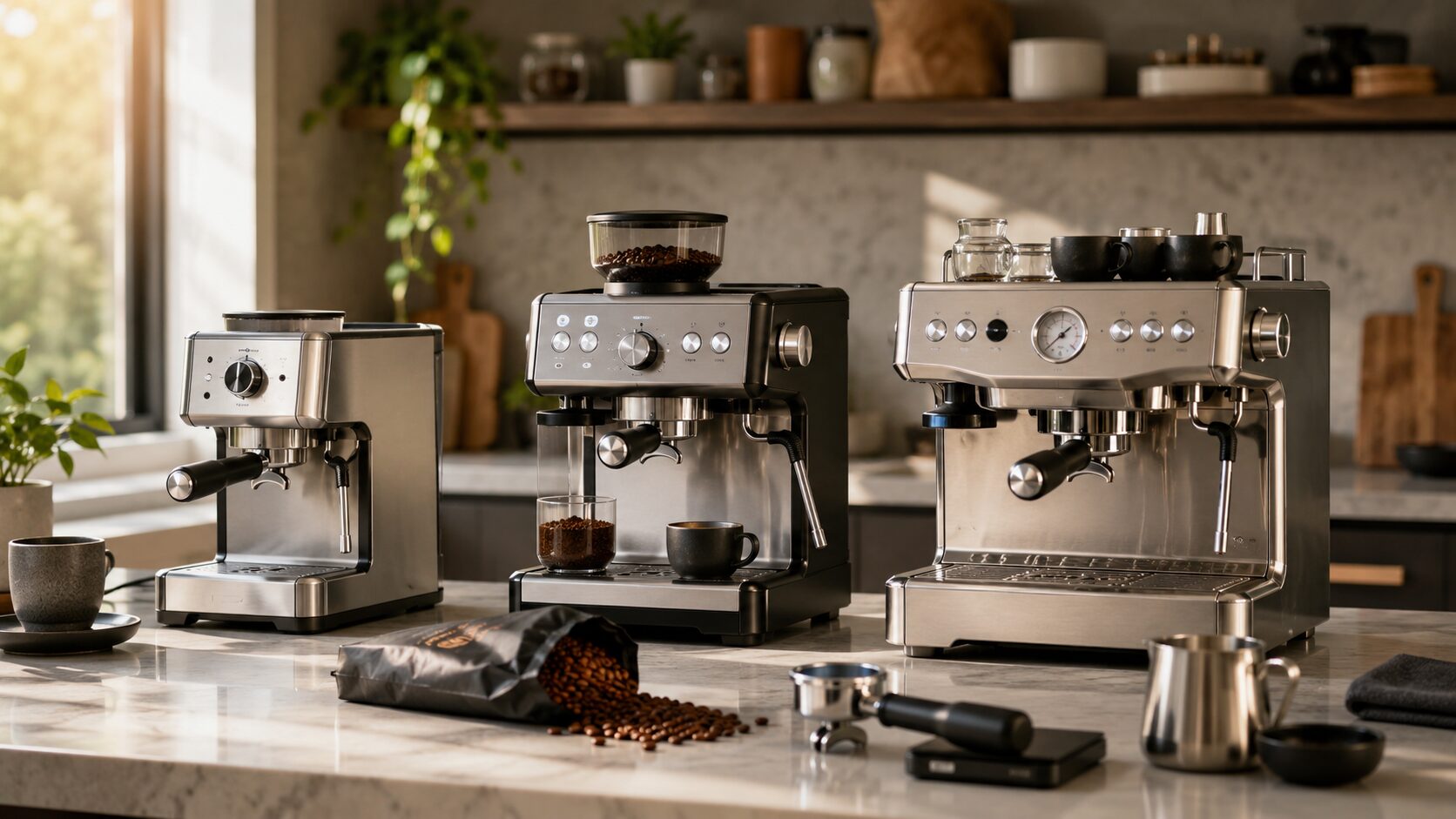
There is something satisfying about making a café-style espresso in your own kitchen. You choose the beans, adjust the grind, prepare the coffee, steam the milk, and slowly learn how small changes can improve the final cup.
But buying an espresso machine can quickly become confusing.
Some machines are designed for beginners. Others give you almost complete control over the brewing process. Some include a grinder, while others require you to buy one separately. Prices can also range from relatively affordable entry-level machines to serious enthusiast equipment costing well over $1,000.
So, which espresso machine is actually worth buying?
In this guide, we look at some of the best espresso machines for home baristas, from compact beginner-friendly models to more advanced machines for coffee enthusiasts.
You will also learn what features matter, whether you need a separate grinder, what type of machine is right for you, and what to consider before spending your money.
Affiliate Disclosure: This article may contain affiliate links. If you purchase through one of these links, we may earn a commission at no additional cost to you. This does not affect our editorial opinions or product recommendations.
Quick Comparison: Best Espresso Machines for Home Baristas
| Espresso Machine | Best For | Grinder | Skill Level |
|---|---|---|---|
| Breville Bambino Plus | Best Overall for Beginners | No | Beginner |
| Breville Barista Express | Best All-in-One Choice | Built-in | Beginner–Intermediate |
| De’Longhi La Specialista Opera | Best for Convenience | Built-in | Beginner–Intermediate |
| Gaggia Classic | Best for Learning Barista Skills | No | Intermediate |
| Rancilio Silvia | Best Traditional Home Barista Machine | No | Intermediate–Advanced |
| Rancilio Silvia Pro X | Best Premium Upgrade | No | Advanced |
| De’Longhi Dedica | Best for Small Kitchens | No | Beginner |
Quick recommendation: For many people starting their home-barista journey, the Breville Bambino Plus offers an appealing balance between ease of use, compact size, fast heating, and milk-steaming convenience. More experienced users who want greater control may prefer a traditional machine such as the Rancilio Silvia or premium Silvia Pro X.
1. Breville Bambino Plus — Best Overall for Beginners
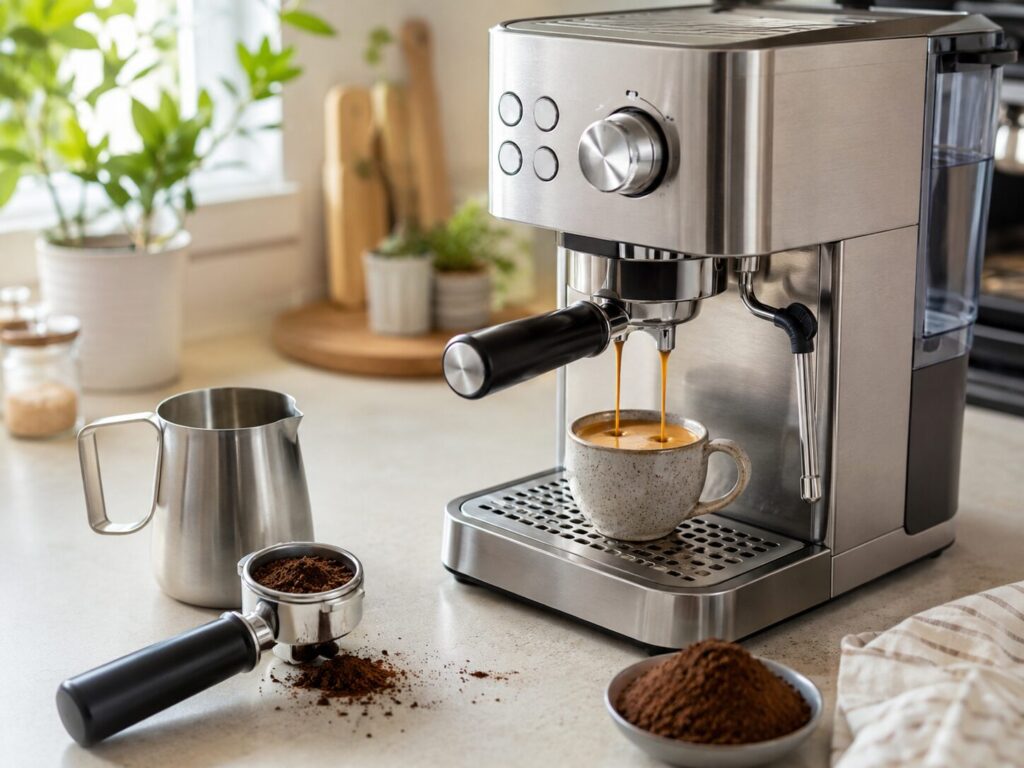
The Breville Bambino Plus is an excellent place to start if you want to make real espresso without filling your kitchen counter with a huge machine.
Its biggest advantage is simplicity.
Breville uses its ThermoJet heating system, which allows the machine to reach its operating temperature in about three seconds. It also includes PID temperature control, low-pressure pre-infusion, and volumetric one- and two-cup controls.
Another beginner-friendly feature is automatic milk texturing. You can select from three milk temperatures and three texture levels, making it much easier to prepare smooth microfoam for cappuccinos and lattes.
Why We Like It
- Very fast heat-up
- Compact footprint
- Automatic milk frothing
- PID temperature control
- Simple controls
- Good introduction to espresso making
- Can also be used for manual milk texturing
Things to Consider
The Bambino Plus does not include a grinder.
That is important because freshly ground coffee is one of the biggest factors in making good espresso. If you don’t already own an espresso-capable burr grinder, you should include one in your total budget.
Best For
The Bambino Plus makes the most sense for beginners, apartment dwellers, latte drinkers, and anyone who wants café-style coffee without a complicated workflow.
Affiliate Link:
[CHECK CURRENT PRICE / BUY BREVILLE BAMBINO PLUS]
2. Breville Barista Express — Best All-in-One Espresso Setup
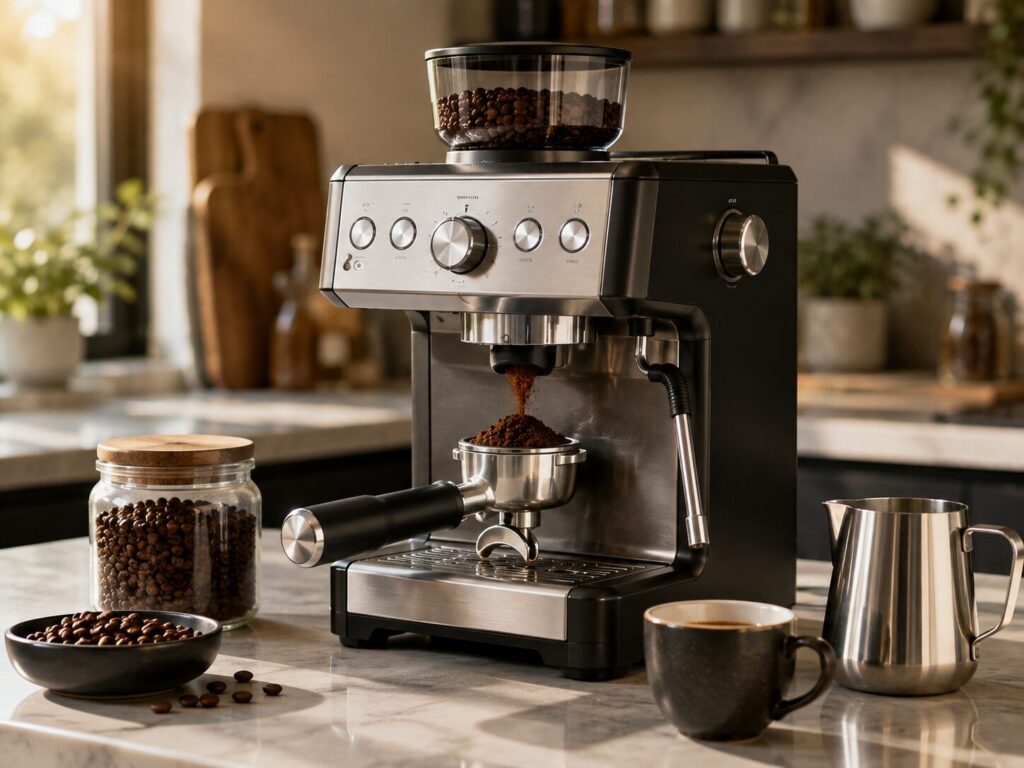
If buying a separate grinder sounds inconvenient, an all-in-one espresso machine can make more sense.
The Breville Barista Express has become a popular style of home espresso setup because it combines the essential parts of the process into one machine.
Instead of having a separate grinder sitting next to your espresso machine, you can grind beans directly before preparing the shot.
That creates a more organized coffee station and can be especially attractive to someone building their first serious home espresso setup.
Why We Like It
- Built-in burr grinder
- Convenient all-in-one design
- Manual steam wand
- Good balance between automation and control
- Allows users to learn espresso preparation
- Reduces the need for separate appliances
You still need to learn basic espresso skills.
For example, grind size, coffee dose, distribution, tamping, extraction time, and bean freshness can all affect the final result.
This is actually part of the appeal.
The Barista Express gives beginners an easier entry point while still providing enough manual involvement to make the process interesting.
Potential Downsides
An integrated grinder provides convenience, but experienced enthusiasts may eventually prefer a dedicated grinder offering more adjustment or upgrade options.
An all-in-one machine also means your grinder and espresso maker share the same appliance footprint and system. Some buyers prefer separate components because they can upgrade each independently.
Best For
Choose this style of machine if you want to go from whole beans to espresso using one main appliance.
Affiliate Link:
[CHECK CURRENT PRICE / BUY BREVILLE BARISTA EXPRESS ]
3. De’Longhi La Specialista Opera — Best for Convenience
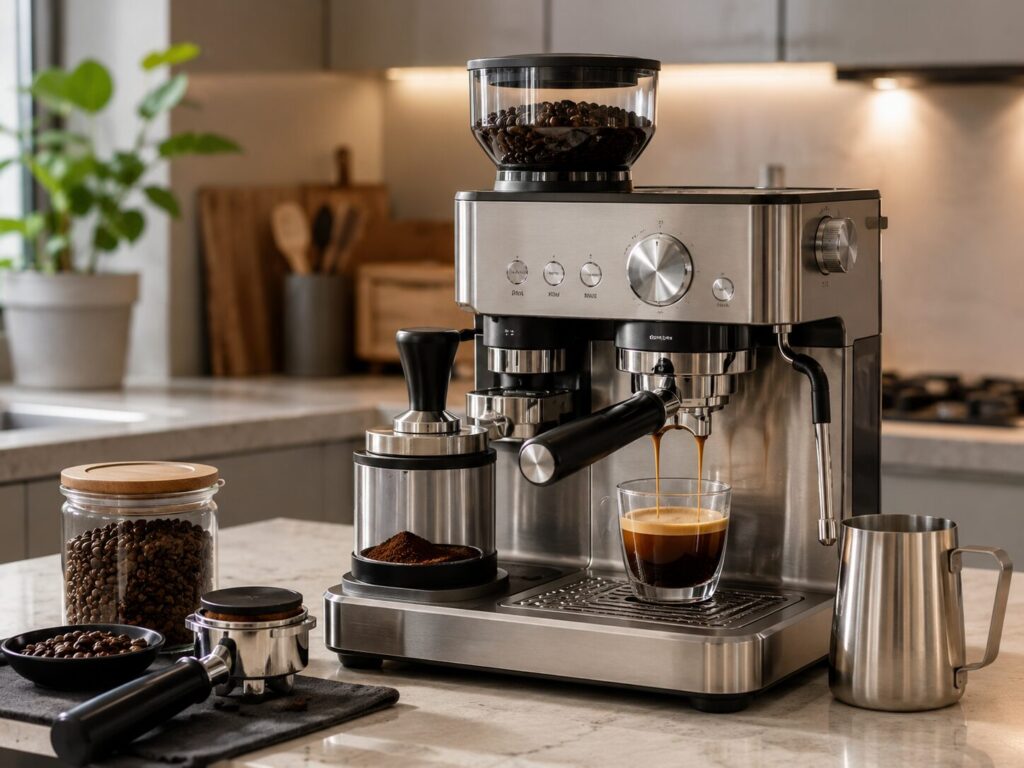
The De’Longhi La Specialista Opera is an interesting option for someone who likes the home-barista experience but wants to remove some of the frustrating parts of the process.
It has a built-in burr grinder with 15 grind settings, Smart Tamping technology, three infusion temperature settings, and a commercial-style steam wand. De’Longhi also offers five preset recipes on the machine: Espresso, Americano, Cold Brew, Espresso Cool, and Hot Water.
The Smart Tamping system is particularly useful for beginners.
Instead of manually trying to produce a perfectly level tamp every morning, the system is designed to make the process cleaner and more consistent.
The machine also provides an interesting combination of traditional espresso and newer drink options. Its Cold Extraction technology allows it to make Cold Brew in under five minutes, according to De’Longhi.
Why We Like It
- Built-in burr grinder
- 15 grind settings
- Smart tamping system
- Multiple temperature settings
- Powerful steam wand
- Hot and cold coffee options
- Beginner-friendly workflow
Things to Consider
Convenience comes at a price.
If your only goal is pulling traditional espresso shots, you may not need all of its additional features.
On the other hand, households that regularly make Americanos, milk drinks, espresso, and cold coffee may get considerably more value from them.
Best For
The La Specialista Opera is a strong choice for people who want a premium all-in-one coffee station without manually controlling every step.
Affiliate Link:
[CHECK CURRENT PRICE / BUY DE’LONGHI LA SPECIALISTA OPERA ]
4. Gaggia Classic — Best for Learning Home Barista Skills
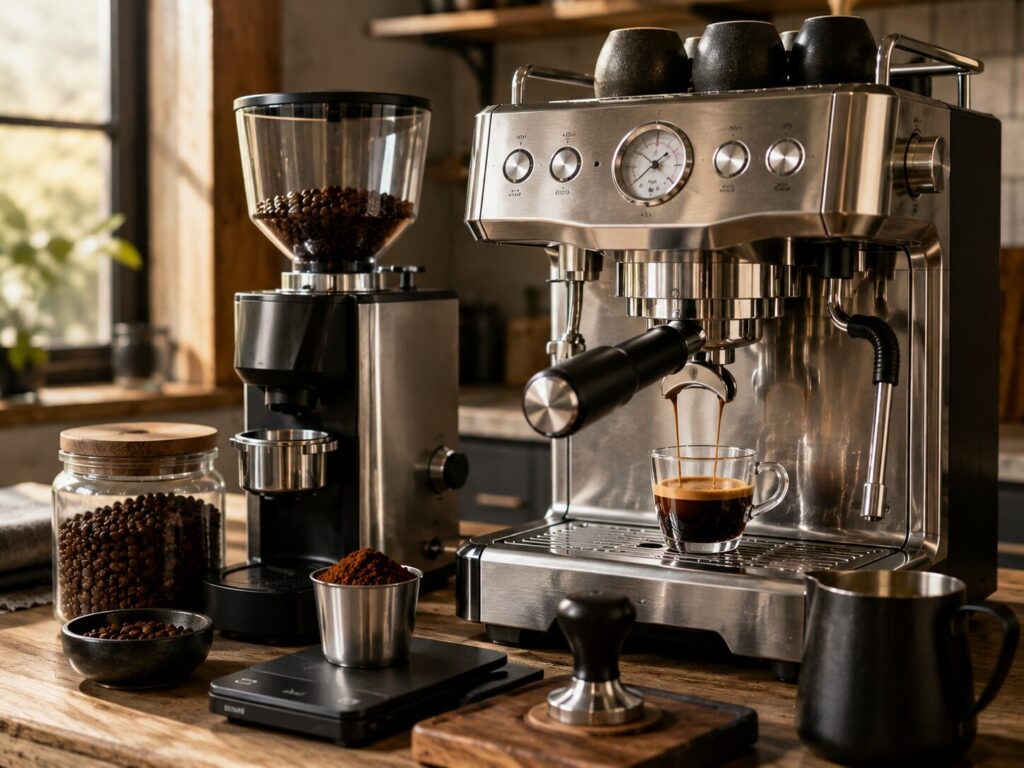
Not everybody wants an espresso machine to do most of the work.
For some coffee lovers, learning is half the fun.
A traditional semi-automatic machine such as the Gaggia Classic is aimed more at people who want to understand how espresso preparation works rather than simply pressing a button.
You grind your coffee, prepare the portafilter, distribute the grounds, tamp the coffee, pull the shot, and steam your own milk.
At first, this workflow can feel more difficult.
But it also teaches you why one espresso shot tastes balanced while another tastes sour, bitter, weak, or overly strong.
Why We Like This Type of Machine
- Hands-on espresso experience
- Traditional home-barista workflow
- Encourages development of real brewing skills
- Good for experimenting with different beans
- Suitable for users who enjoy dialing in espresso
Things to Consider
A machine like this requires patience.
You also need a capable espresso grinder. Buying an expensive espresso machine and pairing it with an inconsistent grinder can seriously limit your results.
Beginners who simply want an easy morning latte may be happier with the Bambino Plus or an integrated-grinder machine.
Best For
The Gaggia Classic is better suited to coffee enthusiasts who enjoy experimenting and want espresso making to become a hobby.
Affiliate Link:
[CHECK CURRENT PRICE / BUY GAGGIA CLASSIC ]
5. Rancilio Silvia — Best Traditional Home Barista Machine
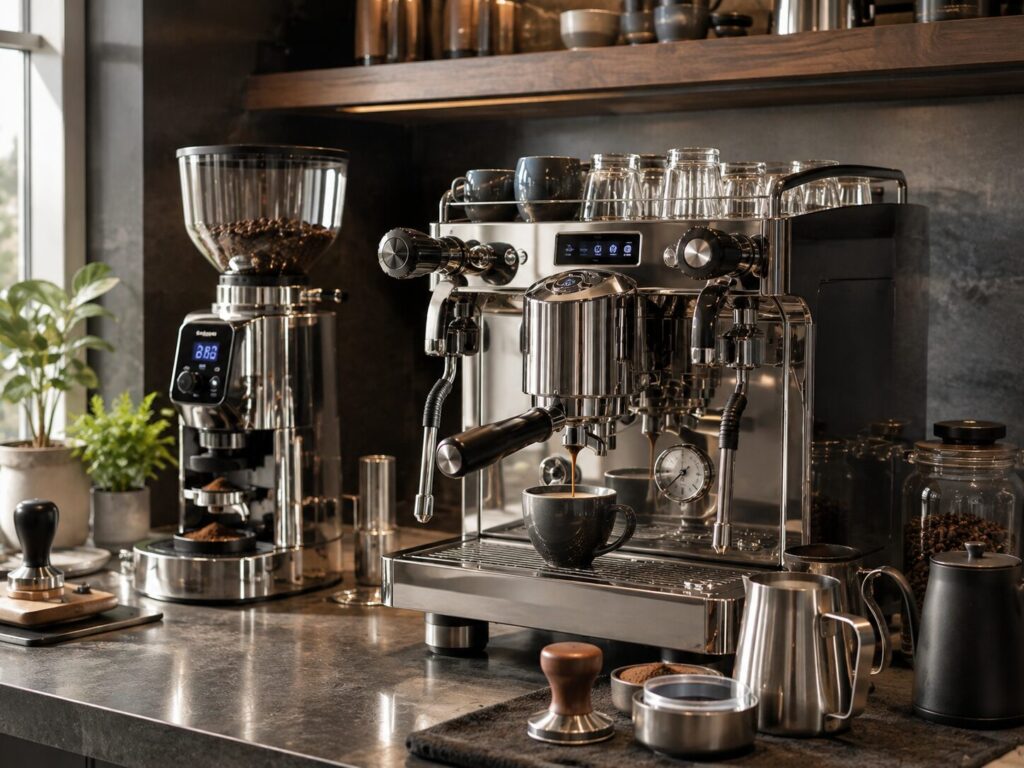
The Rancilio Silvia takes the traditional home-barista experience another step forward.
Rancilio describes the Silvia as a compact single-group home espresso machine incorporating its brewing technology. It uses an ergonomic chrome-plated brass portafilter that can accommodate filters with capacities up to 21 grams.
The machine also features an insulated boiler, stainless-steel steam wand, steam knob, cup tray, and brass brewing unit.
There is less automation here than you will find on many mainstream consumer machines.
For the right buyer, that is an advantage rather than a weakness.
Why We Like It
- Traditional semi-automatic experience
- Solid construction
- Powerful manual workflow
- Designed for serious home espresso
- Capable steam system
- Relatively compact footprint
What You Should Know
The standard Silvia uses a single-boiler design.
That means its workflow is different from more expensive dual-boiler machines designed to handle brewing and steaming more efficiently.
It also does not include a grinder.
You should therefore consider the price of a good grinder when calculating the complete cost of your espresso setup.
Best For
The Silvia is particularly appealing to someone who already understands the basics of espresso and wants a machine that rewards practice.
Affiliate Link:
[CHECK CURRENT PRICE / BUY RANCILIO SILVIA ]
6. Rancilio Silvia Pro X — Best Premium Upgrade
Once espresso becomes a serious hobby, you may start noticing the limitations of entry-level equipment.
Maybe you want tighter temperature control.
Maybe you frequently prepare several milk drinks.
Or perhaps you simply want a machine that gives you more control over your brewing process.
That is where the Rancilio Silvia Pro X becomes interesting.
Unlike the standard Silvia, the Pro X has dual boilers, two PID controllers, a digital display, a pressure gauge, and soft-infusion technology.
The dual-boiler configuration is particularly useful for people who frequently prepare milk-based drinks because brewing and steam functions have independent temperature management.
Why We Like It
- Dual boilers
- PID temperature control
- Digital display
- Soft infusion
- Pressure gauge
- Serious enthusiast-level capabilities
- Strong choice for frequent milk drinks
Things to Consider
This is not an inexpensive beginner machine.
It is also heavier and deeper than the standard Silvia. Rancilio lists the Silvia Pro X at approximately 20 kg (44.1 lb), with dimensions of 250 mm wide, 390 mm high, and 420 mm deep.
Make sure your countertop has enough room before purchasing.
Best For
The Silvia Pro X is for enthusiasts who already know they enjoy making espresso and want equipment they can continue using as their skills improve.
Affiliate Link:
[CHECK CURRENT PRICE / BUY RANCILIO SILVIA PRO X ]
7. De’Longhi Dedica — Best for Small Kitchens
Not everyone has enough counter space for a large espresso station.
If you live in an apartment, have a small kitchen, or simply prefer keeping appliances compact, the De’Longhi Dedica family is worth considering.
The biggest attraction is its slim design.
It provides a more approachable route into home espresso without requiring the amount of counter space associated with many enthusiast machines.
Why We Like It
- Slim design
- Beginner-friendly
- Suitable for smaller kitchens
- Convenient for everyday espresso
- More approachable than enthusiast-level equipment
Limitations
Compact machines naturally involve compromises.
If you eventually become deeply interested in dialing in specialty coffee, experimenting with precise extraction variables, or making several milk drinks back-to-back, you may eventually want more advanced equipment.
But not every coffee drinker needs that.
Best For
This type of machine makes sense for beginners, occasional espresso drinkers, students, apartment residents, and anyone prioritizing countertop space.
Affiliate Link:
[CHECK CURRENT PRICE / BUY DE’LONGHI DEDICA ]
How to Choose the Best Espresso Machine for Your Home
Choosing an espresso machine based only on reviews can lead to buying something that doesn’t fit your lifestyle.
Instead, consider how you actually plan to use it.
1. Decide How Much Work You Want to Do
Espresso machines can generally be divided into several categories.
Manual Machines
These require significant involvement and are best suited to enthusiasts who enjoy controlling the process.
Semi-Automatic Machines
You prepare the coffee and control much of the brewing workflow yourself.
Machines such as the Rancilio Silvia fall broadly into this home-barista category.
Assisted Semi-Automatic Machines
These provide some automation while preserving the experience of making espresso.
The Bambino Plus, for example, combines traditional portafilter preparation with automatic milk texturing.
All-in-One Machines
Models with integrated grinders simplify your setup because you don’t need a separate grinder.
The De’Longhi La Specialista Opera is a good example.
Super-Automatic Machines
These machines prioritize convenience. Many can grind beans and prepare drinks with minimal user involvement.
They are useful, but they provide a very different experience from traditional home-barista espresso preparation.
2. Don’t Ignore the Grinder
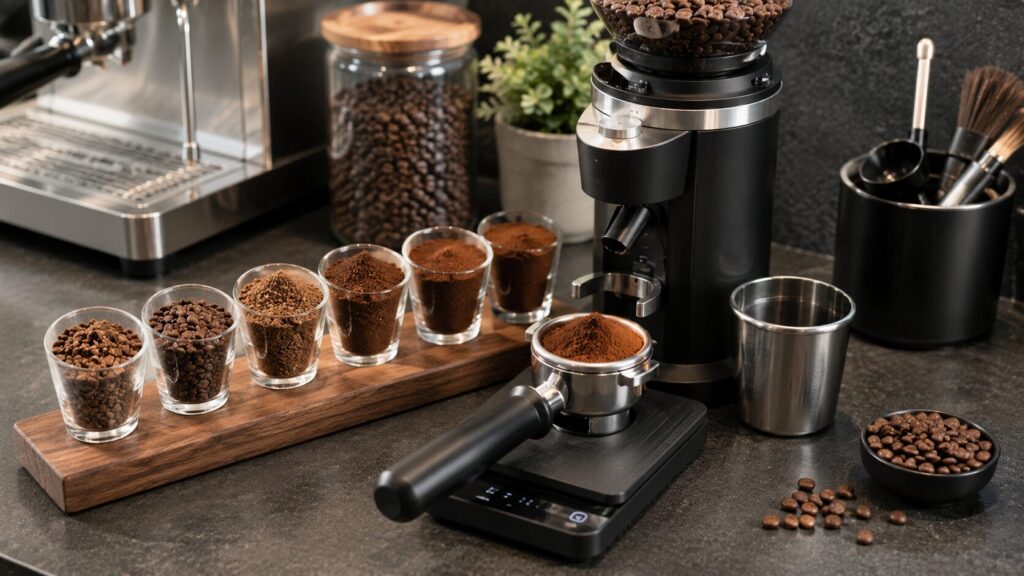
This may be the most important buying advice in this entire guide:
Your grinder matters enormously.
Espresso requires coffee to be ground very finely and consistently.
Even small grind adjustments can dramatically affect how quickly water moves through the coffee puck.
If the grind is too coarse, water may pass through too quickly and produce weak or sour espresso.
If it is too fine, the shot may run extremely slowly and taste harsh or bitter.
A capable espresso grinder allows you to make small adjustments until you find the right extraction for your beans.
Therefore, if you buy a machine without an integrated grinder, reserve part of your budget for one.
Affiliate Link:
[SEE RECOMMENDED ESPRESSO GRINDERS ]
3. Consider What Drinks You Make Most Often
Your favorite coffee drink should influence your purchase.
If you mainly drink straight espresso, focus heavily on temperature stability, extraction control, and grinder quality.
If you love:
- Cappuccino
- Flat white
- Latte
- Cortado
- Macchiato
then steaming performance becomes much more important.
Beginners who make milk drinks every day may appreciate automatic milk texturing.
Experienced users may prefer a strong manual steam wand because it provides greater control over milk texture.
4. Measure Your Countertop
Espresso machines can look smaller online than they do in your kitchen.
Check:
- Machine width
- Machine depth
- Machine height
- Space beneath cabinets
- Water-tank access
- Bean-hopper access
- Clearance for cups
- Grinder space
Remember that machines with top-loading water tanks or bean hoppers may require additional vertical clearance.
You should also leave practical working space around the machine for preparing your portafilter, tamping coffee, steaming milk, and cleaning.
5. Think About Heat-Up Time
If you make coffee before rushing to work, heat-up time matters.
The Bambino Plus is particularly attractive here because Breville states that its ThermoJet system reaches extraction temperature in about three seconds.
Traditional boiler machines can require more preparation time.
Neither approach is automatically better.
A fast-heating machine is convenient. A more traditional setup may appeal more to enthusiasts who are comfortable building a longer espresso routine.
6. Consider Cleaning and Maintenance
Every espresso machine requires maintenance.
Typical jobs include:
- Emptying and cleaning the drip tray
- Rinsing the portafilter
- Cleaning filter baskets
- Wiping and purging the steam wand
- Cleaning the group area
- Backflushing compatible machines
- Descaling when required
- Cleaning a built-in grinder
- Replacing water filters where applicable
Milk residue should not be allowed to build up on a steam wand.
Likewise, coffee oils and old grounds can negatively affect cleanliness and potentially the flavor of your drinks.
Before buying any machine, check the manufacturer’s maintenance instructions.
7. Don’t Choose Based on Pump Pressure Alone
You will often see espresso machines advertised with large pressure numbers such as 15 bar or 19 bar.
Those numbers can sound impressive, but a bigger advertised pump number does not automatically mean better espresso.
What matters is how the machine manages pressure during extraction.
For example, Breville describes the Bambino Plus as using low-pressure pre-infusion followed by 9-bar extraction through its 15-bar pump.
De’Longhi similarly states that the La Specialista Opera uses its 19-bar Italian pump while delivering low pressure during pre-infusion and approximately 9 bars during extraction.
So don’t simply buy whichever box displays the biggest pressure number.
Espresso Machine vs. Coffee Maker: What’s the Difference?
A traditional drip coffee maker and an espresso machine prepare very different drinks.
Drip coffee relies largely on gravity as hot water passes through ground coffee.
Espresso preparation forces hot water through a compact puck of finely ground coffee under pressure.
The resulting drink is concentrated and forms the base for beverages such as:
- Latte
- Cappuccino
- Americano
- Flat white
- Cortado
- Macchiato
If you mostly drink large cups of regular coffee, you may not actually need an espresso machine.
If you regularly buy espresso-based drinks from cafés, however, a home machine may be much more useful.
How Much Should You Spend on a Home Espresso Machine?
There is no single correct budget.
Think about the complete setup rather than just the machine.
Your expenses may include:
Espresso machine + grinder + scale + tamper + milk pitcher + cleaning supplies + fresh coffee beans.
A beginner doesn’t need every accessory immediately.
A sensible approach is to spend most of your initial budget on the machine and grinder, then add accessories once you understand what actually improves your workflow.
Premium accessories cannot compensate for stale coffee or an inconsistent grinder.
Essential Accessories for Home Baristas
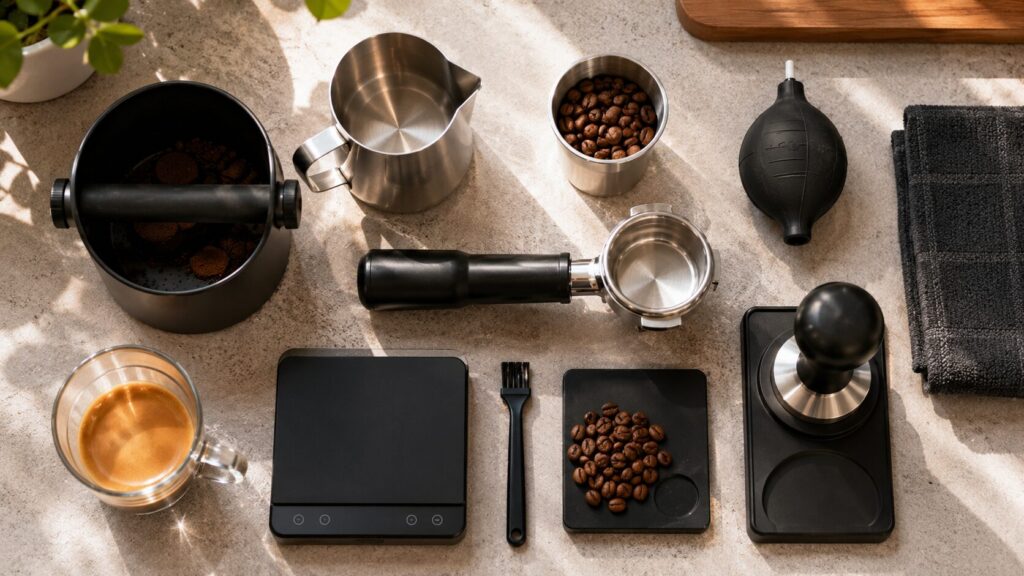
Once you have chosen your machine, a few accessories can make espresso preparation easier.
Espresso Grinder
Essential if your machine doesn’t include one.
Digital Coffee Scale
A scale helps you measure coffee dose and espresso output instead of guessing.
Milk Pitcher
Useful for steaming milk and practicing latte art.
Espresso Tamper
Some machines include one. If yours doesn’t—or if you want a more comfortable option—you can purchase one matching your basket size.
Knock Box
A knock box gives you a convenient place to remove used coffee pucks.
Frequently Asked Questions
What is the best espresso machine for a beginner?
The Breville Bambino Plus is one of the easiest options to consider for a new home barista because it combines a traditional portafilter workflow with fast heating and automatic milk texturing.
If you want a built-in grinder, an all-in-one model such as the Breville Barista Express or De’Longhi La Specialista line may be more convenient.
Do I need an expensive espresso machine?
No.
More expensive machines can provide better temperature management, stronger steaming performance, dual boilers, advanced controls, or premium construction.
But beginners can still make enjoyable espresso using less expensive equipment.
Technique, fresh beans, and grind consistency matter too.
Do I need a grinder?
If your espresso machine doesn’t include one, buying an espresso-capable burr grinder is strongly recommended.
Freshly grinding your beans gives you much more control over extraction.
Is a built-in grinder better?
Not necessarily.
A built-in grinder is extremely convenient and saves counter space.
A separate grinder gives you more freedom to choose or upgrade your grinder independently.
Choose based on your priorities rather than assuming one configuration is universally better.
Are expensive espresso machines easier to use?
Not always.
In fact, some expensive enthusiast machines require more knowledge.
You may need to manually control grinding, dosing, tamping, extraction, temperature, and milk steaming.
Some less expensive consumer machines automate more of these steps and can actually be easier for beginners.
Can a home espresso machine make café-quality coffee?
A capable machine, suitable grinder, fresh coffee, good water, and proper technique can produce excellent espresso at home.
However, buying a premium machine alone does not guarantee excellent results.
Espresso preparation is a skill, and consistency usually improves with practice.
Final Verdict: Which Espresso Machine Should You Buy?
There is no single espresso machine that is perfect for every home barista.
Your best option depends on your experience, budget, available counter space, favorite drinks, and how involved you want to be in the brewing process.
For beginners who want simplicity, the Breville Bambino Plus stands out because of its compact design, extremely fast heating, PID temperature control, and automatic milk texturing.
If you want a grinder built directly into your setup, consider an all-in-one machine such as the Breville Barista Express or De’Longhi La Specialista Opera.
The La Specialista Opera is particularly appealing if you value convenience because it combines grinding, assisted tamping, espresso preparation, milk steaming, and several drink options in one machine.
Coffee enthusiasts who want a more traditional experience should look toward machines such as the Rancilio Silvia.
And if espresso has already become a serious hobby and you are ready for features such as dual boilers and PID temperature management, the Rancilio Silvia Pro X represents a significant step up.
Most importantly, don’t spend your entire budget on the machine while ignoring the grinder.
Good espresso is the result of the entire process: fresh beans, consistent grinding, proper preparation, controlled extraction, quality equipment, and practice.
Start with equipment that matches your current skill level and gives you room to learn.
Then enjoy the process.
Ready to build your home espresso setup?